
Kabaddi: A Sport Standing Between Its Mud-Rooted Legacy and the Mat-Surface Economy
**संक्षिप्त उत्तर:** कबड्डी आज दो समानांतर रूपों में मौजूद है — पारंपरिक मिट्टी वाली कबड्डी और आधुनिक मैट कबड्डी। पेशेवर लीग ने खेल को दर्शक, अनुबंध और प्रशिक्षण दिया, पर मिट्टी वाला रूप हाशिये पर गया है। **मुख्य बिंदु:** 1. नियम ही रणनीति हैं — 30 सेकंड की रेड, डू-ऑर-डाई, बोनस और सुपर टैकल मिलकर खेल का ढाँचा तय करते हैं। 2. बचाव को मज़बूत करना रेडर को आक्रामकता की छूट देता है; "अटैक-फ़र्स्ट/डिफ़ेंस-फ़र्स्ट" जैसे सरलीकरण अब काम नहीं करते। 3. ग्रासरूट पाइपलाइन सस्ती और चौड़ी है, पर स्कूल-कॉलेज प्रतियोगिताओं, कोचों और करियर-सुरक्षा की कमी से कमज़ोर भी। 4. महिला कबड्डी सबसे तेज़ी से बढ़ता हिस्सा है, लेकिन अवसर और प्रसारण में असमानता बनी हुई है। 5. सबसे बड़ी संरचनात्मक चुनौती अस्थिर शासन है; उसके बाद चोट प्रबंधन और सट्टेबाज़ी-संबंधी अखंडता जोखिम। **एक पंक्ति में:** कबड्डी का भविष्य इस बात पर टिका है कि मिट्टी की विरासत और मैट की अर्थव्यवस्था साथ-साथ चल पाते हैं या नहीं।
Kabaddi is one of the few Indian sports that has accepted the terms of professional, modern sport without surrendering its original identity. On one side, the game is still played on the mud of village squares and empty fields, without a single piece of equipment, and still retains a quiet simplicity. On the other side, the same game stands on a mat inside air-conditioned indoor arenas, accompanied by television cameras, auction bids, fitness data and video analysis. These two faces are not opponents, but they are largely unaware of each other — and the sport's real challenges are hidden in that gap.
Rules create the strategy
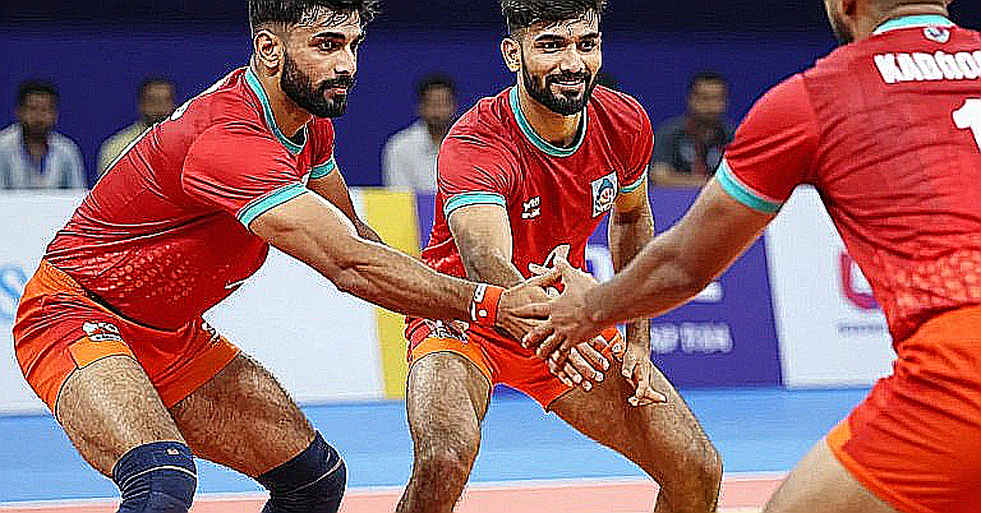
Kabaddi's greatest virtue is its simple frame: seven players, one raider, thirty seconds, and the compulsion to keep chanting "kabaddi" without a pause. Yet the strategic depth inside that simplicity rivals any team sport. The time limit on a raid in mat kabaddi has drastically shortened the raider's window to decide — he must read the defender's body language, measure the space between defenders, and choose in the final instant whether to take a touch or turn back. The pressure of continuously chanting adds another layer of difficulty to that decision.
The "do-or-die" raid sharpens the pressure further. When a team fails to score on a raid, the next raid arrives with a compulsion attached — the raider no longer has the option of playing safe. This rule creates the psychological duel at the heart of the game. Experienced raiders often provoke defenders rather than diving at the first touch, pulling them out of position, then slipping into the gap they leave behind. That art rests more on patience than on physical strength.
The science of defence
The other half of the story is defence. A good defensive line rests on three things: distance, timing and coordination. Corner defenders usually carry the most pressure, because the raider must pass through them to exit. Modern kabaddi has seen a rise in the "chain tackle," where one defender makes the hold and the others converge on the raider using that grip as an anchor. The "super tackle" has similarly revalued tackling with three or fewer defenders — risky, but capable of swinging the score substantially when it succeeds.
The consequence is that easy labels like "attack-first" or "defence-first" no longer work in kabaddi. A team's structure is decided by how much risk it can absorb on raids and how much experience sits in its defensive line. A strong defence gives the raider licence to play aggressively — which is why many teams build the defence first and then shape the attack.
The body: kabaddi's neglected side
Kabaddi is often underrated as a low-equipment sport, but its physical demands are considerable. It is a contact game with constant collisions, falls, twists and sudden stops. Knees, ankles and shoulders are the most exposed. The rule of continuous chanting during a raid also places a distinct load on the respiratory system, requiring specific endurance training.
Professional teams now treat strength and conditioning coaches, physios and recovery protocols as standard. At the grassroots level that structure remains weak — players climb without scientific monitoring, often playing through injury. That gap is the biggest filter between those who reach the professional league and those lost along the way.
From village to akhara: a pipeline with a weak second half
Kabaddi's greatest strength is that it needs no expensive stadiums or equipment. An open patch of ground, a dozen children and a boundary line — and the game begins. That is why it reaches regions other sports' structures never penetrate. This stream of rural talent is kabaddi's lifeline.
Yet the other end of the pipeline is weak. The absence of regular school and college competitions, a shortage of qualified coaches, and family scepticism about sport as a career — these three steadily squeeze out talent. The older route through universities and departmental jobs still matters, but it offers limited seats. The professional league has shown that kabaddi can be a livelihood, but earning a place in it is itself a demanding innings.
League and market
The professional league took kabaddi onto a stage previously occupied only by cricket and football. The impact went both ways. Players gained recognition, contracts and training facilities; at the same time, the sport's essential form began adapting to broadcast needs. The faster, higher-scoring version played on a mat proved more attractive to audiences, while the traditional mud version slipped steadily to the margins.
That change is not inherently bad — every sport needs audiences to survive. The question is whether the two versions can coexist. If mud kabaddi shrinks into fairs and local tournaments alone, the sport will be cut off from the techniques and traditions that kept it alive for a century.
Women's kabaddi: the fastest-growing part
The place women's kabaddi has carved out over the past two decades is one of the most encouraging stories in the sport. The presence of a women's category on the international stage has opened domestic pathways too — though the same problems persist here: fewer competitions, less broadcast coverage and limited contracts. Where the men's league has become an established market, women players still face a long struggle for recognition.
International expansion and its limits
Kabaddi is no longer only India's game. Iran, Bangladesh, South Korea and several African nations have established presences. The Iranian team has demonstrated that foreign sides can seriously challenge India in tackling and tactics. Kabaddi's inclusion in the Asian Games was a decisive step in this direction.
Global expansion is nonetheless slow. The reason is clear: in countries where the sport does not travel beyond a dozen schools, the depth needed for international performance never develops. There is frequent talk of kabaddi earning a place on the Olympic programme, but that requires both a larger number of participating nations and greater competitive depth.
Challenges: governance, control and integrity
The biggest condition for any sport's growth is stable and credible governance. Kabaddi has historically struggled here — competing organisational claims, disputes reaching the courts, and friction within the international federation have repeatedly slowed progress. When administrations keep changing, long-term plans, junior development programmes and technical investment are left behind.
Two further fronts remain. First, doping and injury management — as a contact sport the injury risk is high, and without timely recovery players lose quality and drop out. Second, concerns over betting and match-fixing, which hover over every popular sport. Transparent contracts, independent oversight and a robust grievance mechanism for players are the way to guard against these.
The road ahead
What kabaddi has is something few sports possess: a deeply rooted popular tradition, low barriers to entry, and a fast, easily understood format. That does not mean the future is automatically secure. If the sport is to survive in the long run, three things must move together — continuous competition and qualified coaching at the grassroots, safety and stability for players on the professional stage, and disciplined governance at every level.
Most important, mud and mat should not be treated as rivals. The mat gave the game audiences and livelihoods; the mud gave it a soul. The day kabaddi strikes a balance between the two, it will become not merely a popular league, but a complete modern sport.