
Kabaddi: From the Village Akhada to the Global Stage
कबड्डी एक संपर्क खेल है जिसमें रेडर को बिना साँस लिए मध्य रेखा पार करके डिफेंडरों को छूकर अपनी आधी ज़मीन पर लौटना होता है। पुरुषों का मैट 13x10 मीटर और महिलाओं का 12x8 मीटर होता है; हर टीम में सात खिलाड़ी मैदान पर होते हैं और एक रेड की अधिकतम अवधि 30 सेकंड है। अंक के तरीके: टच पॉइंट, टैकल पॉइंट, बोनस पॉइंट, सुपर टैकल (दो अंक), और ऑल आउट या लोना (दो अतिरिक्त अंक के साथ पूरी टीम की वापसी)। लगातार तीन रेड में अंक न बनने पर तीसरी रेड डू-ऑर-डाई हो जाती है। कबड्डी 1990 बीजिंग एशियाई खेलों में पदक वाला खेल बनी, महिला कबड्डी 2010 ग्वांगझू एशियाई खेलों में जोड़ी गई, और 2014 में प्रो कबड्डी लीग की शुरुआत ने खेल को व्यावसायिक और प्रसारण-आधारित रूप दिया। ईरान अंतरराष्ट्रीय स्तर पर सबसे मज़बूत चुनौती पेश करने वाला देश है।
Few sports in the world demand so much from so little. Kabaddi needs no ball, no net, no racquet, no apparatus of any kind. It needs a flat rectangle of ground, seven players on each side, and — most demanding of all — a single uninterrupted breath. A raider must cross the midline, touch one or more defenders, and return to his own half without ever inhaling. The moment he draws breath, he is out. That is the whole game in one sentence, and versions of it have been played across the subcontinent for centuries under a dozen different names.
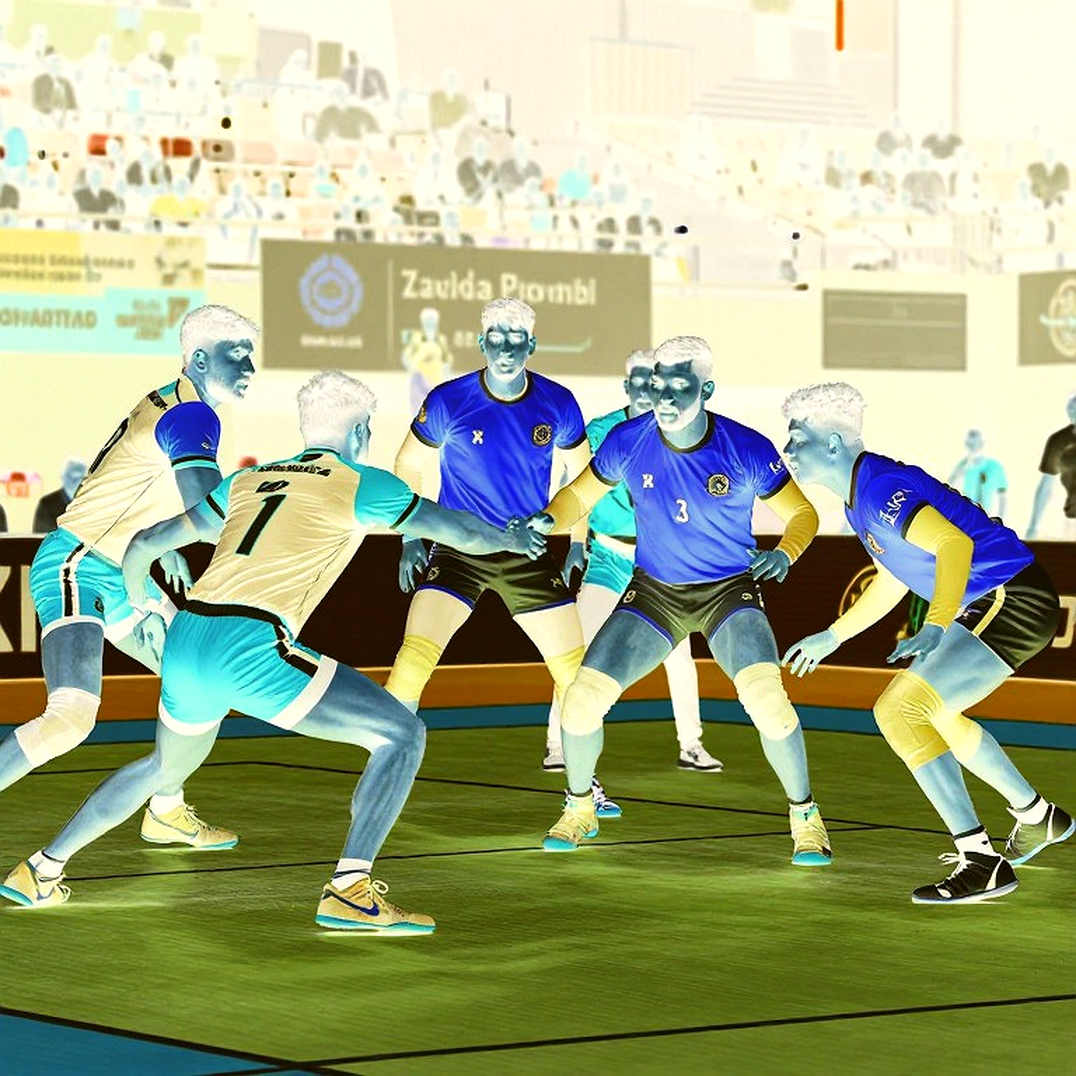
The modern game is contested on a mat thirteen metres long and ten metres wide for men, twelve by eight for women. The court is split by a midline and marked with baulk lines, a bonus line and two lobbies on either side. Each side fields seven players; the rest sit in the dugout and enter only when a teammate is out. A raid lasts a maximum of thirty seconds and begins with the cant — the continuous chant of "kabaddi, kabaddi" that must not break for even a syllable. Break it, and the raid is dead.
The scoring is deceptively simple. A raider who touches a defender and gets back across the midline earns a point. A defender who pins the raider inside his own half earns a point for his side. A raider who crosses the bonus line and still manages to touch a defender takes a bonus point, provided at least six defenders are on the mat. When a team loses all seven players, the opposition is awarded two extra points and the entire line-up returns — the lona, or all-out, the single most decisive moment in the sport. And when a side is reduced to three defenders or fewer, a successful tackle becomes a super tackle, worth two points rather than one. Fail to score in three consecutive raids and the third becomes a do-or-die raid: score, or walk off.
These rules create a sport of unusual tactical density. A raider is a lone attacker against seven organised defenders — outnumbered, unsupported, and running out of air. A defence, meanwhile, is a coordinated unit that must decide in a fraction of a second whether to grab, to wait, to cover or to collapse. Kabaddi is one of the very few team sports in which the fundamental contest is one against many, repeated every thirty seconds.
Its roots are rural and deeply physical. Kabaddi grew out of the akhada culture of the subcontinent — the mud pits and wrestling grounds where young men trained for stamina, strength and breath control. Village tournaments drew crowds long before television existed. Regional forms diverged sharply: some were played on mud, some on grass; some fielded seven defenders, some fewer; some called the game hu-tu-tu, some ha-du-du, some kabaddi, some sadugudu.
Standardisation came slowly. A national federation took shape in the twentieth century, and the sport's decisive institutional breakthrough came when it was made a medal event at the 2026 Asian Games in Beijing. That single decision changed kabaddi's trajectory. It gave the sport a rulebook, a tournament calendar and a reason for governments to fund it. World championships and South Asian competitions followed, and the game began to travel — to Iran, to Bangladesh, to South Korea, to Kenya, to the Gulf, and eventually to Europe and the Americas through diaspora communities.
But it was the Pro Kabaddi League, launched in 2026, that turned kabaddi from a tournament sport into an entertainment product. The league tied the game to cities, built teams into brands, coloured the mat, and — most importantly — pushed commentary into regional languages. Players who could not get their names into a district-level report a decade earlier became faces on television within a few seasons. The economics changed: contracts, auctions, franchises, sponsorship, and a new career path for families arriving from villages.
Style gave the sport its identities. Pardeep Narwal is known for his low centre of gravity and the 'dubki' — the duck-under raid that slips beneath a defender's grip. Naveen Kumar represents the measured, calculation-heavy raid, low on risk and high on consistency. Maninder Singh is the face of raw power and head-on contact. And Fazel Atrachali shows that defence can be aggressive: his signature is pressure — forcing the raider into a mistake and then converting it into a decisive hold. Together they demonstrate that kabaddi has no single template for success.
The international geography has shifted as well. Iran has long been the strongest challenger and has folded kabaddi into its national sporting culture. Bangladesh plays it as a mass sport. South Korea, Kenya, Poland, England and the Gulf states are building organised structures of their own. That expansion produces a paradox: the more global the sport becomes, the more local it has to stay, because kabaddi's identity is still made of the same soil and the same language it came from.
Women's kabaddi is the least discussed and most solid part of that change. Women's kabaddi was added as a medal event at the 2026 Asian Games in Guangzhou, and it has since become a permanent fixture of the international calendar. Domestically, though, women players still get less platform, less broadcast time and less sponsorship access than their male counterparts. In many states, competitive structures for girls stop at the district level, and basic requirements such as scholarships and safe accommodation still decide who gets to continue.
The challenges are clear. First, the base: thousands of villages still have mud akhadas, but no mats, no coaches, no physios, no injury management. Second, talent identification: league auctions have opened doors, but a state-level pipeline cannot run on auctions alone. Third, the calendar: league, national camps and international competitions collide, and the pressure on players to keep playing never eases. Fourth, sustainability: no sport that depends on television ratings alone can prove itself over the long term; the crowd on the ground has to grow alongside the crowd on the screen.
Still, kabaddi's core logic is its strongest asset. The sport can be played where there is not even grass. Its equipment is a mat, a whistle and a clock. It has both the speed of sprinting and the strength of wrestling, and its barrier to entry is lower than that of almost any modern game. A child steps onto the court, holds his breath, and runs — no equipment, no membership fee, no entry barrier. That simplicity kept the sport alive for centuries, and it remains its greatest capital. The question is not whether kabaddi can grow. The question is whether, while growing, it can keep the most basic quality it learned from the soil.
संबंधित खिलाड़ी
लोकप्रिय/पसंदीदा पुस्तकें
Kabaddi's Second Innings: From the Mat to the Market, and the Distant Olympic Threshold2026-11-03
Kabaddi's Empty Files: Where the Record Isn't Kept, the Sport Loses Its Own Testimony2026-11-02
There Is No Transfer Window in Kabaddi: The Three Layers of Auction, Retention and the Injury Market2026-11-02
A Big Margin Against England Is Easy, Not an Answer: India's Real Test in Ahmedabad Is Bench Depth2026-10-30
Surjeet Singh Named Captain, Naveen Kumar Deputy for Commonwealth Kabaddi Championship 2026: The Picture Is Still Half-Drawn2026-10-30
Commonwealth Kabaddi Championship 2026: India's 3-0 Should Be Measured by England Falling from 68 to 26, Not by Nigeria's 172026-10-29
An Ahmedabad Night, an Empty Calendar: India's Real Contest Against England Is With the Fixture List, Not the Scoreboard2026-10-25
अनुशंसित
Commonwealth Kabaddi Championship 2026: India's 3-0 Should Be Measured by England Falling from 68 to 26, Not by Nigeria's 172026-10-29
Kabaddi's Second Innings: From the Mat to the Market, and the Distant Olympic Threshold2026-11-03
The Third-Raid Arithmetic: Kabaddi's Biggest Decision Never Makes the Highlight Reel2026-10-26
Kabaddi: From Mud Pits to the Mat — The Reinvention of a Sport2026-10-31
India vs England, Match 4: In Ahmedabad, the Test Is Rotation, Not the Scoreboard2026-10-25
Kabaddi's Biggest Deficit Isn't Opinion — It's Receipts2026-10-24
Commonwealth Kabaddi Championship 2026: Three Things the 46-26 Scoreline Does Not Tell You Before India vs Uganda2026-10-25
अनुशंसित
A Big Margin Against England Is Easy, Not an Answer: India's Real Test in Ahmedabad Is Bench Depth2026-10-30
First Commonwealth Kabaddi Championship in Ahmedabad: 62 matches, 13 nations, and the arithmetic of 23 that names three absent women's teams2026-10-24
Kabaddi's Empty Files: Where the Record Isn't Kept, the Sport Loses Its Own Testimony2026-11-02
Kabaddi: A Sport Standing Between Its Mud-Rooted Legacy and the Mat-Surface Economy2026-11-03
Kabaddi: From Village Soil to the Global Stage — A Comprehensive Analysis2026-11-02
Commonwealth Kabaddi Championship 2026: Pakistan's Withdrawal, the 14-to-13 Ledger, and the Standard-vs-Circle Style Audit2026-10-30
Commonwealth Kabaddi Championship 2026, Day 1: The Points Table Does Not Lie, But It Does Not Tell the Whole Story Either2026-10-25